
Helping beginners build websites since 2017
400K+
Readers Helped
Updated for 2026
Latest Method
100%
Beginner Friendly
Disclosure: ElegantEspace is supported by readers like you. We may earn an affiliate commission when you purchase through our links. Commissions do not affect our editors’ opinions or evaluations.
Table of Content
- What Is Off-Page SEO?
- Why Is Off-Page SEO Important?
- Off-Page SEO vs. On-Page SEO vs. Technical SEO
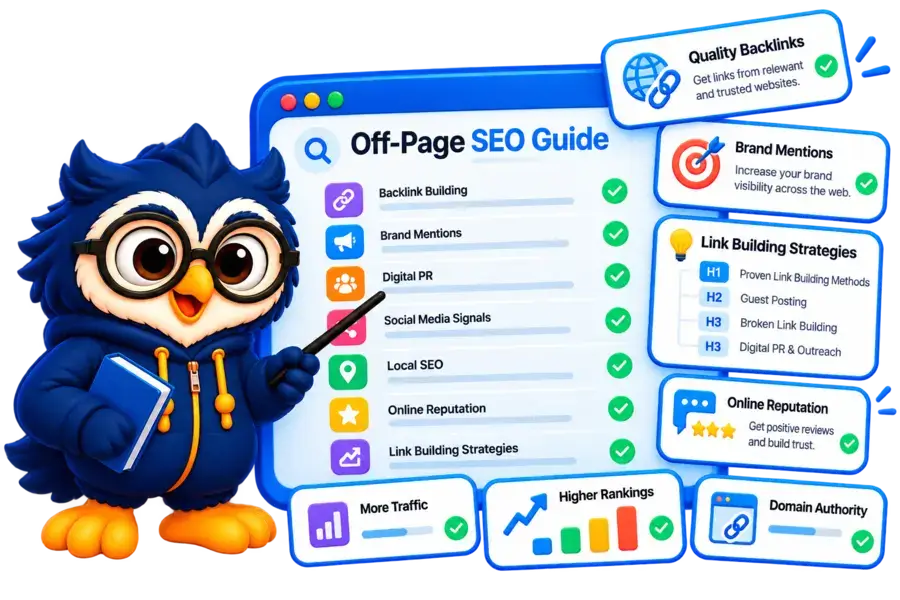
- Key Factors That Influence Off-Page SEO
- How to Build High-Quality Backlinks
- Create Link-Worthy Content
- Guest Posting
- Analyze Competitors' Backlinks
- Broken Link Building
- Find Unlinked Brand Mentions
- Build Industry Relationships
- Create Resource Pages and Useful Tools
- Contribute Expert Insights
- Improve Your Local Online Presence
- Promote Content on Social Media
- How to Evaluate a High-Quality Backlink
- Off-Page SEO Practices to Avoid
- How to Check Your Website's Backlinks
- How to Measure Off-Page SEO Performance
- Common Off-Page SEO Mistakes
- Off-Page SEO Checklist
- FAQs About Off-Page SEO
- Next Lesson
What Is Off-Page SEO?
Off-page SEO refers to activities performed outside your website to improve its reputation, credibility, and search visibility.
It includes earning quality backlinks, building brand awareness, managing online reputation, and developing relationships with relevant websites and industry professionals.
For example, if a reputable technology blog links to your WordPress hosting guide, its readers can discover your website, while the backlink provides search engines with another way to discover and understand your content.
Off-page SEO goes beyond link building. It focuses on establishing your website as a credible and valuable resource across the internet.
Why Is Off-Page SEO Important?
Off-page SEO helps build your website’s reputation beyond its own pages.
It can strengthen your online presence, attract relevant visitors, and support your overall SEO efforts.
Here are its key benefits:
- Builds Website Credibility: Relevant backlinks and genuine industry mentions can help establish your website as a trusted resource.
- Improves Search Visibility: Quality backlinks can help search engines discover your content and understand its connections across the web.
- Increases Referral Traffic: Links from relevant websites can bring visitors who are already interested in your topics.
- Strengthens Brand Awareness: Mentions in publications, communities, and social platforms introduce your brand to new audiences.
- Builds Online Reputation: Genuine reviews, recommendations, and industry relationships help people evaluate and trust your business.
Off-Page SEO vs. On-Page SEO vs. Technical SEO
SEO has three major components: on-page SEO, off-page SEO, and technical SEO.
Each focuses on a different aspect of improving your website’s search visibility.
| SEO Type | Main Focus | Examples |
|---|---|---|
On-Page SEO |
Optimizing website content and individual pages |
Title tags, headings, keywords, images, and internal links |
Off-Page SEO |
Building your website’s reputation beyond its pages |
Backlinks, brand mentions, digital PR, and online reviews |
Technical SEO |
Improving website accessibility and performance |
Site speed, mobile usability, crawling, indexing, and sitemaps |
Example: If you publish a WordPress hosting guide:
- On-page SEO: Optimize its title, headings, content, and images.
- Off-page SEO: Earn relevant backlinks and promote the guide.
- Technical SEO: Ensure the page loads quickly and can be crawled and indexed.
All three work together to support a strong SEO strategy.
Key Factors That Influence Off-Page SEO
Off-page SEO involves more than the number of websites linking to your pages. The context, relevance, and credibility of those references matter.
Here are some important factors to understand.
Backlink Quality and Relevance
A backlink is a link from another website pointing to your website.
Search engines can use links to discover pages and understand how content is connected across the web.
A link from a relevant, trustworthy website can be more valuable than several links from unrelated or low-quality websites.
For example, a backlink to your WordPress hosting guide from a reputable web development publication is more relevant than a link from an unrelated website about gardening.
Referring Domains
A referring domain is a unique website that links to your website.
For example, if three different articles on the same website link to your guide, they represent three backlinks but only one referring domain.
Referring domains help you understand how many distinct websites reference your content.
However, a larger number does not automatically mean a stronger backlink profile. Relevance and quality still matter.
Anchor Text
Anchor text is the clickable text used in a hyperlink.
For example:
<a href=”https://example.com/wordpress-hosting/”>WordPress hosting guide</a>
In this example, “WordPress hosting guide” is the anchor text.
Descriptive anchor text helps readers understand where a link leads. A natural backlink profile can contain branded, descriptive, URL-based, and other relevant anchor text variations.
Avoid trying to control every backlink’s anchor text or repeatedly acquiring links with exact-match commercial keywords.
Link Attributes
Links can contain different attributes that describe their relationship with the linked website.
The most common attributes include:
- Follow links: Ordinary links without a qualifying rel attribute. They can be considered for ranking signals.
- Nofollow links: Links marked with rel=”nofollow”. Google treats this attribute as a hint rather than an absolute instruction.
- Sponsored links: Links marked with rel=”sponsored” to identify advertisements, sponsorships, or other paid placements.
- UGC links: Links marked with rel=”ugc” to identify user-generated content, such as forum posts and comments.
You should understand these attributes, but avoid judging a backlink’s usefulness only by whether it is follow or nofollow.
A nofollow link can still bring relevant visitors, exposure, and referral traffic.
Context and Placement
Where a link appears can influence how useful it is to readers.
A contextual link placed naturally within a relevant article can provide useful information and direct readers to a related resource.
For example, a link to your WordPress security guide within an article discussing website security has a clear purpose.
Links placed in unrelated footers, random directories, or keyword-stuffed comments do not offer the same value.
Focus on earning links that make sense in their context rather than trying to meet a particular backlink count.
How to Build High-Quality Backlinks: 10 Effective Strategies
Link building is the process of earning relevant backlinks from other websites.
The best approach is to create something worth referencing and build genuine relationships with people and publishers in your industry.
Here are ten practical strategies you can use.
Create Link-Worthy Content
One of the most sustainable ways to attract backlinks is to publish original and useful resources.
Other website owners are more likely to reference content that provides information, research, examples, or tools their readers can benefit from.
Some examples of link-worthy content include:
- Detailed industry guides and tutorials.
- Original research and surveys.
- Statistics and data reports.
- Free calculators and online tools.
- Infographics and useful visual resources.
- Practical case studies and experiments.
For example, if you publish an original report comparing the performance of different WordPress hosting providers, other bloggers may reference your findings when writing about website performance.
The more useful and distinctive your content is, the stronger its potential to attract natural backlinks.
Guest Posting
Guest posting involves contributing an article to another website within your industry.
It can help you reach a new audience, demonstrate your expertise, and build relationships with publishers and other professionals.
To get started:
- Find websites that publish content related to your industry.
- Review their existing articles and submission guidelines.
- Identify relevant topics that would benefit their readers.
- Pitch an original article with a clear outline.
- Submit useful, well-written content that meets their editorial standards.
For example, if your website covers WordPress and web hosting, you could contribute an article about website performance, WordPress security, or choosing a hosting provider.
Guest posting should focus on sharing genuine expertise and reaching relevant readers, not producing large numbers of articles solely to acquire backlinks.
Links included in paid or sponsored placements should be qualified appropriately.
Analyze Competitors' Backlinks
Your competitors can provide useful insights into websites, publications, and resources that may be relevant to your own link-building efforts.
By analyzing their backlink profiles, you can discover which pages attract links and identify websites that may also find your content useful.
Follow these steps:
- Identify websites competing with you for similar topics.
- Enter their domains into a backlink analysis tool.
- Review their referring domains and top linked pages.
- Identify websites linking to multiple competitors but not to your website.
- Look for relevant opportunities where your content provides additional value.
Tools such as Semrush Backlink Analytics and Backlink Gap can help you compare backlink profiles and identify potential outreach opportunities.
Remember, a competitor’s backlink is not automatically a good opportunity.
Evaluate the website, its relevance, and the reason it linked to that competitor before contacting it.
Use Broken Link Building
Broken link building involves finding outdated or non-working links on relevant websites and suggesting a useful replacement from your own website.
For example, imagine a technology blog links to a WordPress tutorial that has been removed.
If you have a relevant and helpful guide covering the same subject, you can contact the website owner and suggest it as an alternative.
The process is straightforward:
- Find relevant websites with resource pages or useful articles.
- Check their pages for broken external links.
- Identify the original topic of the missing resource.
- Contact the website owner and politely suggest your resource.
- Look for relevant opportunities where your content provides additional value.
The important part is relevance. Your page should genuinely help readers who would otherwise encounter the broken link.
Find Unlinked Brand Mentions
Sometimes websites mention your business, website, or product without linking to it.
These are called unlinked brand mentions.
For example, an article might mention ElegantEspace while discussing useful websites for learning WordPress, but it may not include a clickable link.
You can look for these opportunities using:
- Google Search.
- Brand monitoring tools.
- Social listening platforms.
- News and media monitoring tools.
When you find a relevant mention, contact the publisher and politely ask whether they would consider linking to your website.
Not every mention needs to become a backlink. The goal is to identify relevant opportunities where a link would provide additional context or value to readers.
Build Relationships With Industry Websites
Building genuine relationships with bloggers, publishers, developers, and industry professionals can create long-term opportunities for collaboration and exposure.
Instead of immediately asking for backlinks, start by engaging with their work.
You can:
- Share useful feedback on their articles.
- Contribute insights to industry discussions.
- Participate in relevant online events.
- Collaborate on research or interviews.
- Recommend useful resources when appropriate.
For example, if you regularly contribute valuable insights to a WordPress community, other members may become familiar with your expertise and reference your content when relevant.
Strong professional relationships can lead to editorial mentions, collaborations, and natural backlinks over time.
Create Resource Pages and Useful Tools
Resource pages collect useful links, tools, guides, and references around a particular subject.
If your website offers a valuable resource, other websites may include it in their own resource collections.
For example, you could create:
- A WordPress tools directory.
- A beginner's website launch checklist.
- A hosting comparison calculator.
- A collection of free SEO resources.
- A detailed guide to website security.
Once your resource is published, identify relevant websites that maintain similar resource pages.
Reach out to them only when your resource genuinely adds value to their collection.
Contribute Expert Insights to Publications and Podcasts
Journalists, bloggers, podcast hosts, and industry publishers often look for experts who can provide useful comments and practical insights.
You can use your knowledge to contribute to these publications.
Some opportunities include:
- Answering relevant media requests.
- Participating in expert interviews.
- Appearing as a podcast guest.
- Contributing quotes to industry articles.
- Joining webinars and online discussions.
For example, if you have experience building WordPress websites, you could share practical advice about website performance, hosting selection, or common WordPress problems.
These contributions can help establish your expertise, increase brand exposure, and sometimes earn editorial backlinks.
Improve Your Local Online Presence
If you operate a local business, local off-page SEO can help customers discover and evaluate your business online.
Start by creating and maintaining an accurate Google Business Profile.
You should also:
- Keep your business name, address, and phone number consistent across relevant directories.
- Get listed on reputable local and industry-specific websites.
- Encourage genuine customer reviews.
- Respond professionally to customer feedback.
- Participate in local events and community activities.
- Earn mentions from relevant local publications and organizations.
For example, a web design agency could build relationships with local business associations, technology communities, and regional publications.
Avoid creating listings on hundreds of unrelated directories. Prioritize platforms that are relevant, trustworthy, and useful to potential customers.
Promote Your Content on Social Media
Social media platforms provide opportunities to distribute your content, connect with your audience, and introduce your website to new people.
Although social media engagement should not be treated as a direct Google ranking factor, content promotion can indirectly support your SEO efforts by increasing exposure and creating opportunities for people to reference your work.
For example, if you publish a detailed WordPress tutorial, you can:
- Share it on LinkedIn with a useful summary.
- Create short tutorial videos for YouTube.
- Turn important points into Instagram carousel posts.
- Share relevant insights in industry communities.
- Participate in discussions on platforms where your audience is active.
Focus on platforms that make sense for your audience rather than trying to maintain an active presence everywhere.
How to Evaluate a High-Quality Backlink
Not every backlink is worth pursuing.
Before spending time on outreach, evaluate whether the linking website and page are relevant, credible, and useful to your audience.
Here are some factors to consider:
| Factor | What to Check |
|---|---|
| Relevance | Does the website or linking page cover a topic related to yours? |
| Editorial Quality | Is the content useful, original, and properly maintained? |
| Credibility | Does the website have a genuine reputation in its industry? |
| Contextual Placement | Does the link fit naturally within the content? |
| Audience Value | Could the link bring relevant visitors to your website? |
| Link Purpose | Was the link earned naturally, or was it created primarily to manipulate rankings? |
| Website Quality | Does the website publish trustworthy content, or is it filled with spam and unrelated links? |
SEO tools may provide metrics such as Authority Score, Domain Rating, or Domain Authority to help compare websites.
However, these are third-party metrics, not Google ranking factors.
Use them as supporting indicators rather than treating a particular score as proof that a backlink is valuable.
A relevant editorial link from a trusted website can be more useful than many links from unrelated or low-quality websites.
Off-Page SEO Practices to Avoid
Not every link-building tactic is safe. Some methods attempt to manipulate search rankings instead of earning genuine references.
Google identifies these practices as link spam when they are used primarily to manipulate rankings.
Avoid the following
Buying Backlinks for Ranking Purposes
Paying website owners for links that pass ranking credit violates Google’s link spam policies.
If you pay for advertising or sponsorship, qualify the link using rel=”sponsored” or an appropriate rel=”nofollow” attribute.
Excessive Link Exchanges
Exchanging links occasionally between relevant websites may happen naturally.
However, excessive arrangements created primarily to manipulate rankings can violate Google’s policies.
Automated Link Building
Avoid tools and services that automatically create large numbers of backlinks through comments, profiles, directories, or unrelated websites.
These links rarely provide meaningful value and may create an unnatural link profile.
Forum and Blog Comment Spam
Participating in relevant discussions can help you build relationships and share knowledge.
However, posting keyword-rich links in forum comments or signatures purely to acquire backlinks is a spam tactic.
Contribute useful information and include a link only when it genuinely helps answer the discussion.
Low-Quality Directory Submissions
Submitting your website to unrelated directories or bookmark sites solely to acquire backlinks is not a sustainable strategy.
Focus on reputable directories that serve a real audience or industry purpose.
Manipulative Guest Posting
Publishing large volumes of low-quality guest articles with keyword-rich backlinks designed to manipulate rankings can violate link spam policies.
Guest contributions should provide original value to the publication’s readers.
The safest approach is to focus on useful content, genuine relationships, and editorially earned references rather than shortcuts.
How to Check Your Website's Backlinks
Regularly reviewing your backlink profile helps you understand which websites link to your content, identify useful opportunities, and spot unusual patterns.
You can use the following tools.
Google Search Console
Google Search Console provides a Links report that shows information about external links pointing to your website.
To check your backlinks:
- Open Google Search Console.
- Select your website property.
- Navigate to Links in the left-hand menu.
- Review the Top linking sites report.
- Check the Top linked pages report.
- Export the available data if you want to analyze it further.
This is a useful starting point for understanding which websites and pages are linking to your content.
Semrush Backlink Analytics
Semrush provides backlink analysis reports that help you review your backlink profile and compare it with competitors.
You can use it to explore:
- Total backlinks.
- Referring domains.
- New and lost backlinks.
- Anchor text distribution.
- Follow and nofollow link attributes.
- Referring website information.
You can also use its Backlink Gap tool to identify websites linking to your competitors but not to your website.
Ahrefs
Ahrefs provides backlink analysis features through its Site Explorer tool.
You can review referring domains, backlinks, anchor text, linked pages, and new or lost links.
These insights can help you identify content that attracts backlinks and discover potential link-building opportunities.
Remember that backlink tools have different indexes and may report different totals.
No single tool provides a complete record of every link on the internet.
How to Measure Off-Page SEO Performance
Off-page SEO is a long-term activity, so measuring your progress is important.
Instead of focusing only on the total number of backlinks, track several indicators that show whether your efforts are improving your website’s visibility and reputation.
| Metric | What It Tells You |
|---|---|
| Referring Domains | How many unique websites link to your website. |
| Backlink Quality | Whether your links come from relevant and credible sources. |
| New and Lost Backlinks | How your backlink profile changes over time. |
| Referral Traffic | How many visitors arrive through links on other websites. |
| Brand Mentions | How frequently your business or website is referenced online. |
| Branded Search Performance | Whether more people are searching for your brand. |
| Organic Search Performance | Whether your website is gaining impressions, clicks, and visibility. |
| Conversions | Whether visitors from your off-page activities become leads or customers. |
You can use Google Search Console to monitor organic search performance and Google Analytics 4 to analyze referral traffic and conversions.
Backlink analysis tools can help you monitor referring domains and link changes, while brand monitoring tools can help you track online mentions.
Review these metrics regularly rather than expecting immediate improvements after every backlink or campaign.
Common Off-Page SEO Mistakes to Avoid
Even when you understand off-page SEO, some common mistakes can waste time and weaken your overall strategy.
Here are a few to avoid:
- Focusing only on backlink quantity: A large number of low-quality links does not automatically improve your website's authority.
- Ignoring website relevance: A link from an unrelated website may have little value to your audience.
- Using manipulative anchor text: Repeatedly building exact-match keyword links can create an unnatural backlink profile.
- Ignoring your existing content: Outreach is less effective when your website has few useful resources worth referencing.
- Overlooking brand reputation: Backlinks are important, but customer feedback, expert references, and genuine brand mentions also matter.
- Expecting instant results: Building a recognizable online presence and earning meaningful backlinks takes consistent effort.
- Ignoring performance measurement: Without tracking your progress, it is difficult to identify which activities are producing useful results.
A sustainable off-page SEO strategy focuses on relevance, credibility, and long-term value rather than quick ranking shortcuts.
Off-Page SEO Checklist
Use this checklist to organize your off-page SEO activities and keep track of your progress.
Website Preparation
Backlink Building
Brand and Online Reputation
Performance Monitoring
Use this checklist whenever you publish new content or update existing pages.
Regularly reviewing these elements helps maintain your website’s content quality and technical health.
Frequently Asked Questions About Off-Page SEO
1. What is the difference between on-page SEO and off-page SEO?
On-page SEO focuses on optimizing elements within your website, such as content, headings, title tags, images, and internal links.
Off-page SEO focuses on activities outside your website, such as earning backlinks, building brand awareness, managing online reputation, and getting references from relevant websites.
2. Are backlinks important for off-page SEO?
Yes.
Backlinks are an important part of off-page SEO because they help search engines discover pages and understand how websites are connected.
However, relevance, quality, and the context of a link matter more than simply increasing the total number of backlinks.
3. How do I build high-quality backlinks?
You can build high-quality backlinks by publishing link-worthy content, contributing useful guest articles, analyzing competitor backlinks, finding broken links, earning unlinked brand mentions, and building relationships with relevant publishers and industry experts.
4. Are social media links a ranking factor?
Social media engagement and links should not be treated as direct Google ranking factors.
However, sharing useful content can increase its visibility, attract visitors, encourage brand discovery, and create opportunities for other websites to reference your content.
5. What is the difference between follow and nofollow backlinks?
A follow link is an ordinary link without a qualifying rel attribute. A nofollow link includes rel=”nofollow”, which tells Google that the publisher does not want to associate with the linked page or follow it in the usual way.
Google treats nofollow as a hint, so it should not be assumed that every nofollow link has no value.
6. Is guest posting still effective for SEO?
Guest posting can help you reach new audiences, demonstrate expertise, and build relationships with relevant publishers.
However, publishing low-quality articles primarily to acquire backlinks can violate Google’s link spam policies.
Focus on original contributions that genuinely benefit the publication’s readers.
7. How long does off-page SEO take to show results?
There is no fixed timeline for off-page SEO results.
It depends on factors such as your website’s current reputation, competition, content quality, outreach efforts, and the relevance of the websites referencing you.
Building a strong online presence generally requires consistent work over time.
8. Can off-page SEO alone improve website rankings?
Off-page SEO can support search visibility, but it should not be treated as a replacement for on-page and technical SEO.
Your website still needs useful content, a clear structure, and a technically sound foundation to provide a good experience for visitors and search engines.
9. Is off-page SEO a one-time activity?
No.
Off-page SEO is an ongoing process. You should continue publishing useful resources, building industry relationships, monitoring your backlink profile, managing your online reputation, and promoting your content.
10. What are the best tools for off-page SEO?
Some useful tools include Google Search Console for reviewing links, Semrush and Ahrefs for backlink analysis, Google Analytics 4 for referral traffic, and brand monitoring tools for tracking online mentions.
The best combination depends on your website, goals, and budget.
- What Is Off-Page SEO?
- Why Is Off-Page SEO Important?
- Off-Page SEO vs. On-Page SEO vs. Technical SEO
- Key Factors That Influence Off-Page SEO
- How to Build High-Quality Backlinks
- Create Link-Worthy Content
- Guest Posting
- Analyze Competitors' Backlinks
- Broken Link Building
- Find Unlinked Brand Mentions
- Build Industry Relationships
- Create Resource Pages and Useful Tools
- Contribute Expert Insights
- Improve Your Local Online Presence
- Promote Content on Social Media
- How to Evaluate a High-Quality Backlink
- Off-Page SEO Practices to Avoid
- How to Check Your Website's Backlinks
- How to Measure Off-Page SEO Performance
- Common Off-Page SEO Mistakes
- Off-Page SEO Checklist
- FAQs About Off-Page SEO
- Next Lesson
Continue Your SEO Journey
Build your skills one step at a time with these essential SEO guides.
Technical SEO
Improve site health
Help search engines discover, crawl, and index your important website pages effectively.
Misconceptions About SEO
Separate facts from myths
Understand common SEO myths, avoid outdated practices, and discover what really matters for better search visibility.


One recent method of getting quality backlinks naturally is by making infographics and distributing it to inforgraphics websites. Infographics easily tell various data, facts through image and a carefully crafted inforgraphic has the potential to go viral thereby getting natural backlinks.
Thanks for the post and now i can say that i am much more clear on off page seo
Nice article Pragati , Thanks for shairing
There are methods for magicians of each skill level.
Unique information always attracts the readers, so write on unique topic anyhow i like your website because the alexa rank is quite good.
Really good information shared with us..
Really good information shared with us..
Good article. You have explained off page seo in very simple way without going too deep in technical part.
Thanks for sharing this post.
Thank you so much for this information
Hey Really thanks for sharing useful information…
Your place is valuable for me. Thanks!
Such an amazing guide about Off-Page SEO.
Thanks for sharing.
It’s really valuable and will help me to optimize my future blog posts.
Thanks for the tips. Blog commenting was very popular a few years back but I feel it’s popularity has decreases, but not its importance.
It’s good to see the leading seo blogs to mention blog commenting again and try to make people realize of their importance.
Hello,
Your post is really helpful for me, and you are correct if we don’t work on On-Page SEO then the hard work to get Better Quality Backlinks is wasted.
SEO title and Description play an important role. I will opt for the idea of Broken Links, it really works well to Get Quality Backlinks for Our Website.
Your Full Article is very useful for beginners and those who have just basic knowledge about SEO.
The way you explain about Off-Page is Impressive, giving examples.
Thank You Sir, for sharing this article.