
Helping beginners build websites since 2017
400K+
Readers Helped
Updated for 2026
Latest Method
100%
Beginner Friendly
Disclosure: ElegantEspace is supported by readers like you. We may earn an affiliate commission when you purchase through our links. Commissions do not affect our editors’ opinions or evaluations.
Table of Content
- Introduction
- What Is Google Search Console?
- Why Is Google Search Console Important for SEO?
- How to Set Up Google Search Console
- How to Verify Your Website Ownership
- Understanding the Google Search Console Dashboard
- How to Use the Performance Report
- How to Monitor Website Indexing
- How to Use URL Inspection
- How to Submit an XML Sitemap
- Other Important Google Search Console Reports and Features
- Final Thought
Getting your website to appear in Google Search is only the beginning.
To understand how people discover your website, which keywords bring visitors, and whether Google can properly access your pages, you need the right SEO tools.
Google Search Console (GSC) is a free tool from Google that helps website owners monitor their search performance, identify indexing issues, understand search queries, and improve their website’s visibility in Google Search.
Whether you manage a blog, affiliate website, business website, or online store, Google Search Console provides valuable insights into how your website performs in organic search.
In this guide, you’ll learn how to set up Google Search Console, understand its important reports, monitor indexing, analyze search performance, and use its data to identify SEO improvement opportunities.
By the end, you’ll know how to use Google Search Console as part of your regular SEO workflow.
What Is Google Search Console?
Google Search Console (GSC), formerly known as Google Webmaster Tools, is a free service provided by Google that helps website owners monitor and manage their website’s presence in Google Search.
It provides information about how Google discovers, crawls, and indexes your website, along with how your pages perform in organic search results.
With Google Search Console, you can:
- Monitor clicks, impressions, average CTR, and average position.
- Discover which search queries bring visitors to your website.
- Check whether your pages are indexed by Google.
- Identify crawling and indexing issues.
- Submit XML sitemaps.
- Inspect individual URLs.
- Monitor Core Web Vitals and website experience reports where data is available.
- Review security issues and manual actions.
How Does Google Search Console Work?
Google Search Console collects information about your website’s performance and how Google interacts with its pages.
Here’s a simplified overview:
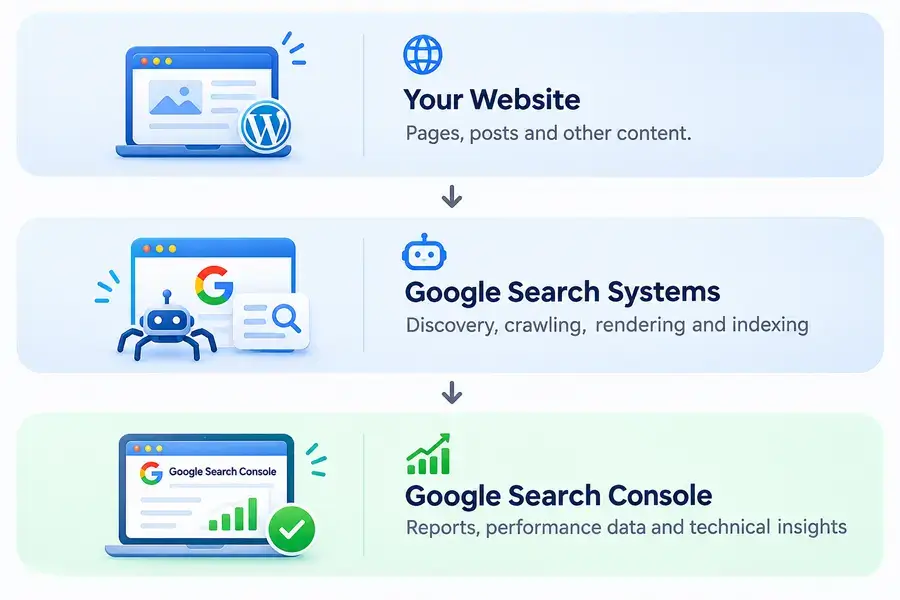
Google Search Console then helps you understand how your website appears in Google Search and identify areas that may need attention.
Is Google Search Console Free?
Yes. Google Search Console is completely free to use. You don’t need a paid subscription to access its main reports and features.
You only need a Google account and a verified website property to get started.
You can access it here: Google Search Console.
Important:
Google Search Console is not a complete website analytics tool. It focuses on Google Search performance and technical search information. To analyze visitor behavior, engagement, and conversions on your website, you can use Google Analytics 4 alongside it.
Why Is Google Search Console Important For SEO?
Google Search Console helps you understand how your website performs in Google Search and identify opportunities to improve its organic visibility.
Instead of guessing which pages are performing well or why certain pages aren’t appearing in search results, you can use actual search data and Google’s reported website information to make informed decisions.
Here are six important ways Google Search Console helps with SEO.
1. Monitor Organic Search Performance
The Performance report shows how your website appears in Google Search.
You can monitor:
- Total Clicks: How many times users clicked your website in search results.
- Total Impressions: How often your pages appeared in search results.
- Average CTR: The percentage of impressions that resulted in clicks.
- Average Position: Your website's average position in search results for the selected data.
These metrics help you understand whether your search visibility and organic traffic are improving.
2. Discover Keywords That Bring Visitors
Google Search Console shows the actual search queries for which your website receives impressions and clicks.
You can use this information to:
- Discover keywords already bringing visitors.
- Find queries generating impressions but few clicks.
- Identify new content opportunities.
- Find relevant keywords to include in existing articles.
- Understand which search queries drive traffic to specific pages.
For example, if an article receives impressions for a relevant keyword but has a low CTR, you can review its title and meta description.
3. Identify Indexing Problems
Publishing an article doesn’t guarantee that Google will index it.
Google Search Console helps you identify pages that are indexed and URLs that haven’t been indexed, along with reported reasons.
You can investigate issues such as:
- Crawled, currently not indexed.
- Discovered, currently not indexed.
- Blocked by robots.txt.
- Excluded by noindex.
- Page not found (404).
- - Duplicate pages and canonical issues.
This helps you identify which pages need attention.
4. Monitor Website Performance and User Experience
Google Search Console provides a Core Web Vitals report based on real-user experience data when sufficient data is available.
You can monitor:
- Largest Contentful Paint (LCP).
- Interaction to Next Paint (INP).
- Cumulative Layout Shift (CLS).
These reports help identify groups of URLs that may need performance improvements.
5. Find and Fix Technical SEO Issues
Google Search Console helps you identify technical problems that may affect how Google accesses and understands your website.
Depending on the issue and available reports, you can investigate:
- Crawling problems.
- Sitemap processing errors.
- Indexing issues.
- Mobile and Core Web Vitals problems.
- Security issues.
- Manual actions.
6. Monitor Your Website's Search Visibility Over Time
You can compare performance across different periods to understand how your website is progressing.
For example, you can:
- Compare clicks and impressions month over month.
- Identify pages losing organic traffic.
- Monitor changes in keyword performance.
- Evaluate the impact of content updates.
- Identify pages gaining search visibility.
This makes Google Search Console useful for ongoing SEO monitoring rather than just initial website setup.
Takeaway:
Google Search Console helps you understand what is happening with your website in Google Search. By regularly reviewing its reports, you can identify technical issues, discover keyword opportunities, improve existing content, and make better SEO decisions.
How To Set Up Google Search Console
Setting up Google Search Console is the first step toward monitoring your website’s performance in Google Search.
You need a Google account and access to your website’s verification method.
The setup process is straightforward and usually takes only a few minutes.
Follow these steps to connect your website.
Open Google Search Console

- Visit Google Search Console
- Sign in using your Google account.
- Click Start now if you're accessing it for the first time.
- You'll see an option to add a website property.

Google Search Console offers two property types: Domain and URL prefix.
Choose a Property Type
Google Search Console offers two ways to add your website.

1. Domain Property
- Enter your root domain, such as example.com.
- Tracks all subdomains.
- Includes HTTP and HTTPS versions.
- Requires DNS verification.
2. URL-Prefix Property
- Enter your complete website URL, such as https://www.example.com/.
- Tracks only URLs matching that prefix.
- Supports multiple verification methods.
- Useful for tracking a specific website section or protocol.
For most website owners, a Domain property is the better starting point because it combines data across subdomains and protocols.
Enter Your Website Domain
If you choose the Domain property:
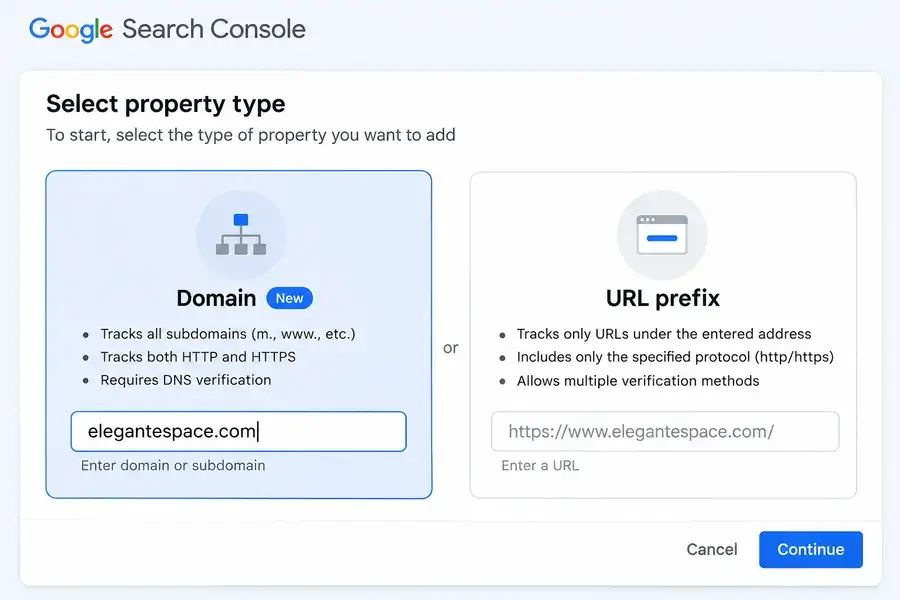
- Enter your root domain without https:// or www.
- Click Continue.
- Google Search Console will provide a DNS verification record.
- Keep this information available for the ownership verification process.
For example:
elegantespace.com
Don’t enter:
https://www.elegantespace.com/
Complete The Initial Setup
After adding your property, Google Search Console will ask you to verify website ownership.
Choose the verification method and follow the instructions displayed by Google.
We’ll cover the available verification methods and their WordPress implementation in the next section.
Important Things to Know
- Adding a property does not change your website or its Google Search rankings.
- Search Console data may take a few days to appear.
- Adding a property and verifying ownership are separate steps.
- If you already have a verified property, you can select it instead of creating another one.
How To Verify Your Website Ownership
After adding your website property to Google Search Console, the next step is to verify that you own or manage the website.
Google requires ownership verification before you can access the property’s Search Console data and manage its settings.
The verification method depends on the property type you selected.
Understand The Verification Methods
Google Search Console supports several website ownership verification methods.
| Method | How It Works |
|---|---|
| DNS record | Add a TXT record to your domain's DNS settings. |
| HTML file | Upload a verification file to your website's root directory. |
| HTML tag | Add a meta verification tag to your homepage. |
| Google Analytics | Verify using an existing Google Analytics setup. |
| Google Tag Manager | Verify using an existing Tag Manager container. |
Verify a Domain Property Using DNS
If you select the Domain property, Google will ask you to add a DNS verification record.
Follow these steps:
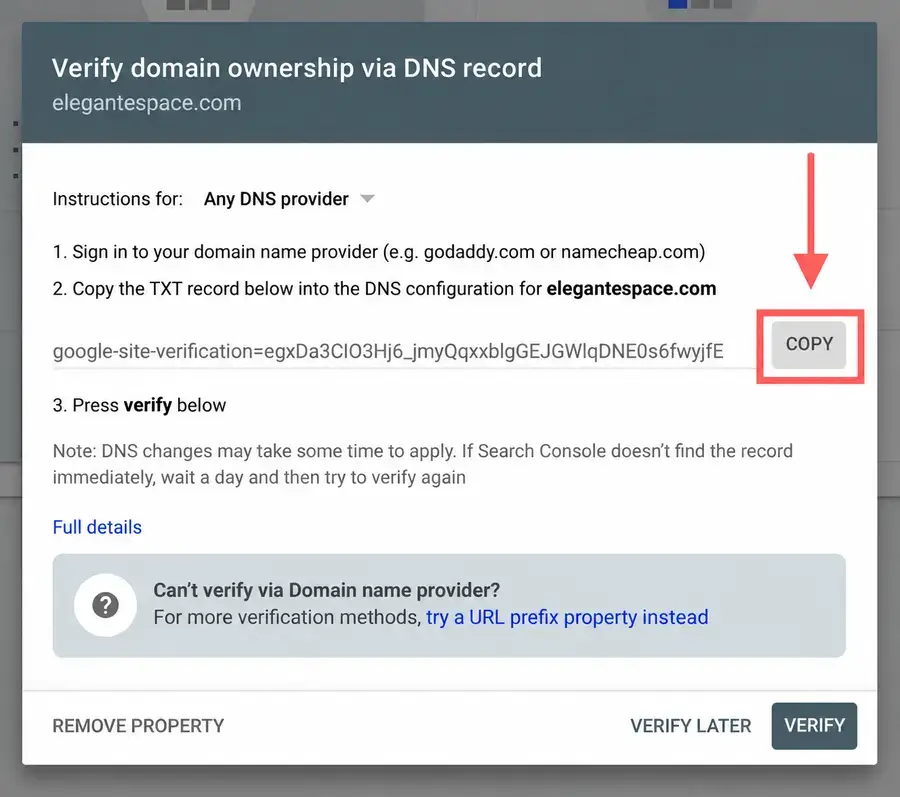
- Select the DNS verification method in Google Search Console.
- Copy the TXT record provided by Google.
- Log in to your domain registrar or DNS provider.
- Open your domain's DNS management settings.
- Add a new TXT record.
- Enter the host/name and TXT value as instructed by your DNS provider.
- Save the record.
- Return to Google Search Console and click Verify.
Example of a DNS TXT record:
					Type: TXT
Name: @
Value: google-site-verification=YOUR_UNIQUE_CODE
Where Do You Add The DNS Record?
You add it wherever your domain’s DNS is managed. This could be your domain registrar, hosting provider, or Cloudflare.
For example, if your domain uses Cloudflare DNS:
- Log in to Cloudflare.
- Select your domain.
- Open DNS → Records.
- Click Add record.
- Select TXT.
- Enter the details supplied by Google.
- Save the record.
Verify a URL-Prefix Property Using an HTML Tag
If you selected the URL-prefix property, you can use an HTML meta tag to verify ownership.

- Select HTML tag from the available verification methods.
- Copy the meta tag provided by Google.
- Open your WordPress dashboard.
- Add the verification code to your website's header file section.
- Save your changes.
- Return to Google Search Console and click Verify.
If you don’t know how to edit your theme files.
Here are two convenient options:
Using Yoast SEO

- Navigate to Yoast SEO → Settings → Site connections.
- Find the Google verification field.
- Paste the verification code requested by Yoast.
- Save your changes.
Use the verification value from Google’s meta tag, not the entire HTML tag, if the field asks for a verification code.
Using Google Site Kit
- Go to Plugins → Add New Plugin.
- Search for Site Kit by Google.
- Install and activate the plugin.
- Open Site Kit → Dashboard.
- Connect your Google account.
- Follow the setup instructions to connect Search Console.
Confirm Successful Verification
After completing verification:

- Return to Google Search Console.
- Check for the ownership verification success message.
- Click Go to Property to open your dashboard.
- Keep your verification method in place.
Important:
Don't remove your DNS record, HTML verification tag, or verification file after successful verification. Google periodically checks verification methods, and removing the required token can cause you to lose verified ownership.
Understanding The Google Search Console Dashboard
When you open Google Search Console, you’ll see a dashboard containing different reports and tools.
These help you understand how Google discovers, crawls, and indexes your website, as well as how your pages perform in Google Search.
Let’s look at the main sections.
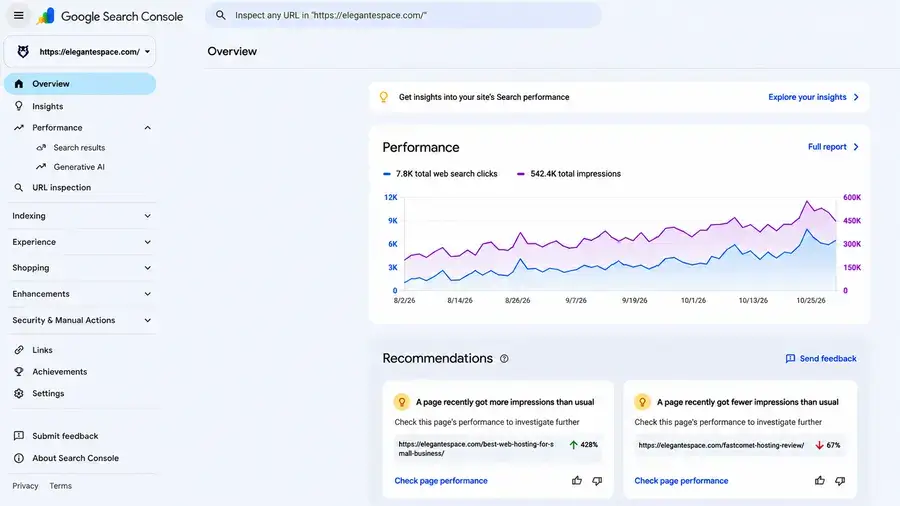
Property Selector
The property selector appears near the top of the navigation panel.
It allows you to switch between the websites or properties you’ve added to Google Search Console.
If you manage multiple websites, select the property you want to analyze before opening a report.
Overview
The Overview page provides a summary of your website’s performance and technical status.
Depending on the data available for your property, you may see summaries related to:
- Search performance
- Indexing
- Page experience
- Enhancements and other reports
URL Inspection
The URL Inspection tool allows you to check how Google views a specific page on your website.
Enter a URL in the inspection bar to find information about its indexing status, crawl details, and any detected issues. You can also request indexing for eligible pages.
We’ll explore this tool in detail in a later section.
Performance
The Performance section helps you understand how your website appears across Google Search and its generative AI experiences.
It includes traditional search performance data as well as a Generative AI performance report, where available.
Traditional Search Performance
- Total clicks: How many times users clicked your website in Google Search.
- Total impressions: How many times your website appeared in search results.
- Average CTR: The percentage of impressions that resulted in clicks.
- Average position: The average position of your website's highest-ranking result for a search.
You can also explore search queries, pages, countries, devices, and search appearance to understand which content attracts visibility and traffic.
Generative AI Performance
The Generative AI performance report provides insights into your website’s visibility in Google’s AI-powered search experiences, including AI Overviews and AI Mode.
You can use this report to:
- Monitor impressions from generative AI search experiences.
- Identify which website pages appear in AI-generated search results.
- Analyze visibility by country and device.
- Track changes in your website's AI search visibility over time.
This report helps you understand how your content is appearing in Google’s evolving search experiences, beyond traditional search results.
Note: The Generative AI report may not be available for every website. Its availability depends on whether Google has enough relevant data for your property.
Indexing
The Indexing section helps you understand which pages Google has discovered and indexed.
It commonly includes:
- Pages: Shows indexing information and reasons some pages are not indexed.
- Sitemaps: Allows you to submit and monitor your XML sitemap.
- Removals: Helps you request temporary removal of URLs from Google Search.
These reports are useful for identifying indexing problems and monitoring your website’s coverage.
Experience
The Experience section provides reports related to the user experience of your website.
Depending on the available data, you may find:
- Core Web Vitals: Reports on loading performance, interactivity, and visual stability.
- HTTPS: Shows information about the HTTPS status of your website's pages.
- Removals: Helps you request temporary removal of URLs from Google Search.
Use these reports to identify experience-related issues that may need attention.
Enhancements
The Enhancements section displays reports for supported structured data types detected on your website.
For example, if Google detects eligible structured data, you may see reports showing valid items and errors that need attention.
Not every website will have the same enhancement reports. Their availability depends on the structured data Google detects and supports.
Security & Manual Actions
This section helps you identify serious problems that may affect your website’s presence in Google Search.
- Manual Actions: Shows whether Google has applied a manual action to your website for violating its spam policies.
- Security Issues: Reports security problems such as hacked content or harmful software.
Check these reports if you notice unexpected drops in search visibility or receive a notification from Google.
Links
he Links report shows information about links pointing to and within your website.
It includes:
- External links: Links from other websites pointing to your pages.
- Internal links: Links connecting pages within your website.
- Top linking sites: Websites that link to your content.
- Top linked pages: Pages on your website that receive the most links.
You can use this information to understand your website’s link profile and internal linking structure.
Settings
The Settings section contains property-level configuration and management options, including ownership verification details, user permissions, and other property settings.
Use it when you need to manage access or review how your Search Console property is configured.
Important:
The reports and options visible in your dashboard may vary depending on your website, available data, and Google's current reporting features. Some reports appear only when Google detects relevant information.
How To Use The Performance Report
To open the report, select your website property in Google Search Console and navigate to Performance → Search results.
You’ll see a performance chart with four key metrics:

Understand The Four Performance Metrics
The report includes four important metrics:

- Total clicks: The number of times users clicked your website in Google Search results.
- Total impressions: The number of times a link to your website appeared in Google Search results.
- Average CTR: The percentage of impressions that resulted in clicks. For example, if your page receives 1,000 impressions and 50 clicks, its CTR is 5%.
- Average position: The average position of your website's highest-ranking result for a search query.
You can enable or disable these metrics by selecting their respective boxes above the chart.
Apply Search Filters
Google Search Console allows you to filter performance data to investigate specific areas of your website.
- Search type: Filter results by Web, Image, Video, or News, depending on available data.
- Query: Find performance data for a particular keyword or search phrase.
- Page: Analyze a specific URL on your website.
- Country: See where your search traffic originates.
- Device: Compare performance across desktop, mobile, and tablet.
- Search appearance: Filter by supported search result features.
Use the date filter to select the period you want to analyze. You can choose a preset range or set a custom date range.
For example, you can review the last 28 days to understand recent performance or compare the last three months with the previous period to identify changes.
Find SEO Opportunities Using The Performance Report
The real value of this report comes from using its data to make better SEO decisions.
Here are a few practical ways to use it:
- Find high-impression, low-CTR keywords: Review queries with many impressions but relatively few clicks. Consider improving your page title and meta description where appropriate.
- Identify pages losing traffic: Compare date ranges to find pages with declining clicks or impressions. Investigate ranking changes, search intent, and content relevance.
- Discover keyword opportunities: Find queries where your website receives impressions but could perform better. Check whether the relevant page fully answers the searcher's intent.
- Identify your best-performing pages: Find pages generating the most clicks and use their performance to understand what content works well.
- Review mobile performance: Compare mobile and desktop results to identify differences in search visibility and investigate potential usability issues.
Tip:
Don't make SEO decisions based on a single metric. Review clicks, impressions, CTR, and average position together to understand what's happening before changing a page.
How To Monitor Website Indexing
To monitor your website’s indexing status, open Google Search Console, select your property, and navigate to Indexing → Pages.
The Page indexing report provides information about which pages Google has indexed and which pages it has not indexed.
Understand The Page Indexing Report
The report generally groups URLs into two main categories:
- Indexed: Pages Google has successfully indexed and may show in search results.
- Not indexed: Pages Google has discovered or processed but has not included in its index.
You can review the reported reasons to understand why certain URLs are not indexed.
Common Reasons Pages Are Not Indexed
Not every non-indexed page indicates an SEO problem. Some pages are intentionally excluded, while others may need attention.
Here are some common indexing statuses:
| Status | What It Means |
|---|---|
| Discovered - currently not indexed | Google knows about the URL but hasn't crawled it yet. |
| Crawled - currently not indexed | Google crawled the page but hasn't indexed it. |
| Excluded by 'noindex' tag | The page contains a directive asking search engines not to index it. |
| Alternate page with proper canonical tag | Google recognizes another URL as the preferred version. |
| Page with redirect | The URL redirects to another page. |
| Not found (404) | The requested page returns a 404 error. |
| Blocked by robots.txt | Google's crawler is prevented from accessing the URL by robots.txt. |
| Server error (5xx) | Google encountered a server-side error while accessing the page. |
How To Fix Common Indexing Issues
Once you identify an indexing issue, investigate whether the affected URL should appear in Google Search.
Discovered - Currently Not Indexed
- Check whether the page is linked from relevant pages on your website.
- Include the URL in your XML sitemap if it is important.
- Make sure your website's server is accessible.
Crawled - Currently Not Indexed
- Review whether the page provides useful, original information.
- Check for duplicate or very similar content.
- Improve the page if it does not sufficiently satisfy the search intent.
Excluded By 'noindex' Tag
- Check whether the page is intentionally excluded.
- If it should appear in search results, remove the unwanted noindex directive.
- Check your SEO plugin settings if you're using WordPress.
Page With Redirect or 404 Error
- Update internal links pointing to outdated URLs.
- Redirect important moved pages to relevant replacement URLs.
- Restore deleted pages if they are still needed.
Blocked By Robots.txt or Server Error
- Review your robots.txt rules to ensure important pages are not blocked.
- Check your hosting and server configuration if Google encounters 5xx errors.
Validate Your Fixes
After resolving an indexing issue, return to the Page indexing report and select the relevant issue.
Click Validate Fix if the option is available. Google will then check whether the reported problem has been resolved.
Validation can take time, and it does not guarantee that Google will index every affected page.
Check Your Indexed Pages Regularly
Make it a habit to review the Page indexing report periodically.
Pay attention to:
- Important pages that are not indexed.
- Sudden increases in non-indexed URLs.
- Pages affected by unexpected noindex directives.
- Server errors and crawling problems.
- Changes in indexed page counts.
Important:
Your goal should not be to index every URL on your website. Search filters, duplicate pages, redirects, and other URLs may not need indexing. Focus on ensuring that your important, useful, search-ready pages are accessible and eligible for indexing.
How To Use URL Inspection in Google Search Console
To use this tool, open your Google Search Console property and enter the complete page URL in the URL Inspection bar at the top of the dashboard.
For example:
https:// elegantespace.com/what-is-seo/
Press Enter to inspect the URL.
Check The URL's Indexing Status
After inspection, Google Search Console displays information about the URL’s availability in Google Search.
You may see different statuses, including:
- URL is on Google: Google has indexed the page, and it may appear in search results.
- URL is not on Google: The page is not currently indexed. Review the reported reason.
- URL is unknown to Google: Google has not discovered or processed the URL.
If the page is not indexed, review the details provided to understand what needs attention.
Review Page Indexing Details
The URL Inspection report provides useful information about how Google processes a page.
Depending on the URL and available data, you can review:
- Last crawl: When Google last crawled the page.
- Crawled as: The Googlebot type used to crawl the page.
- Crawl allowed: Whether Google was allowed to crawl the URL.
- Page fetch: Whether Google could successfully retrieve the page.
- Indexing allowed: Whether the page is permitted to be indexed.
- User-declared canonical: The canonical URL specified by your website.
- Google-selected canonical: The URL Google considers the preferred version.
Test The Live URL
If you’ve recently published or updated a page, click Test Live URL.
Google will check the current version of the page to see whether it can be accessed and whether it meets the technical requirements for indexing.
This can help you identify issues such as:
- Page fetch failures.
- Robots.txt restrictions.
- Noindex directives.
- Mobile rendering or page-loading problems.
Remember that a successful live test does not guarantee that Google will index the page.
Request Indexing
After publishing a new page or making significant updates, you can request Google to crawl it.
Follow these steps:
- Enter the page URL in the URL Inspection bar.
- Wait for the inspection results.
- If you've made changes, select Test Live URL.
- Once the live test is complete, select Request Indexing if available.
- Wait for Google to process the request.
When Should You Use URL Inspection?
You don’t need to inspect every page every day. Use this tool when:
- You've published an important new article.
- You've made significant updates to an existing page.
- A page is missing from Google Search.
- You've fixed a technical indexing issue.
- You want to check Google's selected canonical URL.
- You need to investigate a crawling or page-fetch problem.
Tip:
Use URL Inspection for individual pages and the Page indexing report to monitor indexing issues across your entire website. Together, these tools make it easier to manage your website's indexing health.
How To Submit an XML Sitemap to Google Search Console
Submitting an XML sitemap helps Google discover your URLs, but it does not guarantee indexing or higher rankings.
Focus on submitting clean, relevant URLs that you want Google to consider for search results.
Want to learn more? Read our guide on How to Create an XML Sitemap in WordPress for a practical, step-by-step tutorial.
Other Important Google Search Console Reports and Features
Apart from Performance, Indexing, URL Inspection, and Sitemaps, Google Search Console provides several other reports and tools that help you monitor your website’s technical health, security, links, and search visibility.
Let’s explore the most useful ones.
Core Web Vitals
The Core Web Vitals report helps you understand the real-world experience users have when visiting your website.
It evaluates three important performance metrics:
- Largest Contentful Paint (LCP): Measures how quickly the main content of a page loads.
- Interaction to Next Paint (INP): Measures how quickly a page responds to user interactions.
- Cumulative Layout Shift (CLS): Measures unexpected layout movement while a page loads.
Google groups URLs into Good, Needs Improvement, and Poor categories based on these metrics.
Use this report to identify pages that may need performance improvements.
HTTPS Report
The HTTPS report provides information about the HTTPS status of your website’s URLs.
It helps you identify pages that may have HTTPS-related problems.
Make sure your website uses a valid SSL certificate and that important pages load securely over HTTPS.
Links Report
The Links report helps you understand how other websites and your own pages link to your content.
It includes:
- External links: Links from other websites pointing to your website.
- Internal links: Links between pages on your website.
- Top linking sites: Websites that link to your content.
- Top linked pages: Pages receiving the most external links.
- Top linking text: Common anchor text used in external links.
You can use this information to review your backlink profile and improve your internal linking structure.
Manual Actions
Google may issue a manual action if a human reviewer determines that your website violates Google’s spam policies.
Examples include:
- Unnatural links to or from your website.
- Automatically generated spam content.
- Cloaking or sneaky redirects.
- Thin content created primarily to manipulate search rankings.
If Google applies a manual action, the report explains the issue and the affected pages.
Review the problem, fix the violations, and submit a reconsideration request when the necessary changes have been made.
Security Issues
The Security Issues report alerts you when Google detects security problems on your website.
These may include:
- Hacked content.
- Malware.
- Deceptive pages.
- Harmful downloads or other security threats.
If an issue appears, investigate it immediately and clean up the affected pages. Once the problem is resolved, request a review through Search Console if required.
Removals Tool
The Removals tool allows website owners to request temporary removal of specific URLs from Google Search results.
You can use it to:
- Temporarily hide a URL from Google Search.
- Clear a cached result in eligible cases.
- Review requests submitted for your property.
Important: A temporary removal is not a permanent solution. To keep a page out of search results, use an appropriate method such as a noindex directive or access restriction, depending on your requirements.
Search Console Insights
Search Console Insights helps website owners understand how their content performs and how people discover it through Google Search.
Depending on the available data and interface, it can provide insights into:
- Your most popular content.
- Content receiving increased attention.
- Search queries bringing visitors to your website.
Use these insights to identify successful content and find opportunities to improve your content strategy.
Note: Reports and features may vary depending on your property, available data, and Google’s current Search Console interface. Some reports only appear when relevant information is available.
Important: A temporary removal is not a permanent solution. To keep a page out of search results, use an appropriate method such as a noindex directive or access restriction, depending on your requirements.
Final Thoughts
Google Search Console is an essential tool for anyone who wants to understand and improve their website’s visibility in Google Search.
From monitoring search performance and discovering keyword opportunities to identifying indexing problems and checking technical health, it provides valuable information about how Google interacts with your website.
Start by verifying your website, submitting your XML sitemap, and exploring the Performance and Indexing reports. Make it a regular part of your SEO workflow and use its insights to improve your content and website over time.
Remember, better SEO comes from understanding the data, identifying opportunities, and consistently making improvements.
- Introduction
- What Is Google Search Console?
- Why Is Google Search Console Important for SEO?
- How to Set Up Google Search Console
- How to Verify Your Website Ownership
- Understanding the Google Search Console Dashboard
- How to Use the Performance Report
- How to Monitor Website Indexing
- How to Use URL Inspection
- How to Submit an XML Sitemap
- Other Important Google Search Console Reports and Features
- Final Thought


It’s actually a nice and useful piece of information. I am happy that you
simply shared this helpful information with us.
Please stay us up to date like this. Thank you for sharing.
Thanks for writing such a good article on Google Webmaster tool. I am looking to try these techniques for my website birchi.in . Your tips are helpful for the person to make good blog marketing for their websites or blog. This content is so valuable and surely unique that people are happy and really helpful for them. there is no any other ways to get customers than Google indexing and Marketing and no any pressure from your side. Neither in the form of request nor hint or reminder in any ways.
Thanks
Thanks for showing it up with images practically
Rajeev, You are most welcome.