
- October 2026
Shopify Review (2026): Features, Pricing, Pros & Cons
Shopify is an ecommerce platform that helps you build an online store, sell products, and manage orders from one place. Explore its features, pricing, limitations, and alternatives to decide whether Shopify is the right choice for your business.
- Ecommerce Features Explained
- Plans and Transaction Fees
- Pros and Cons
- Best Shopify Alternatives
Find out what Shopify does best, where it falls short, and whether it’s worth the investment for your online store.
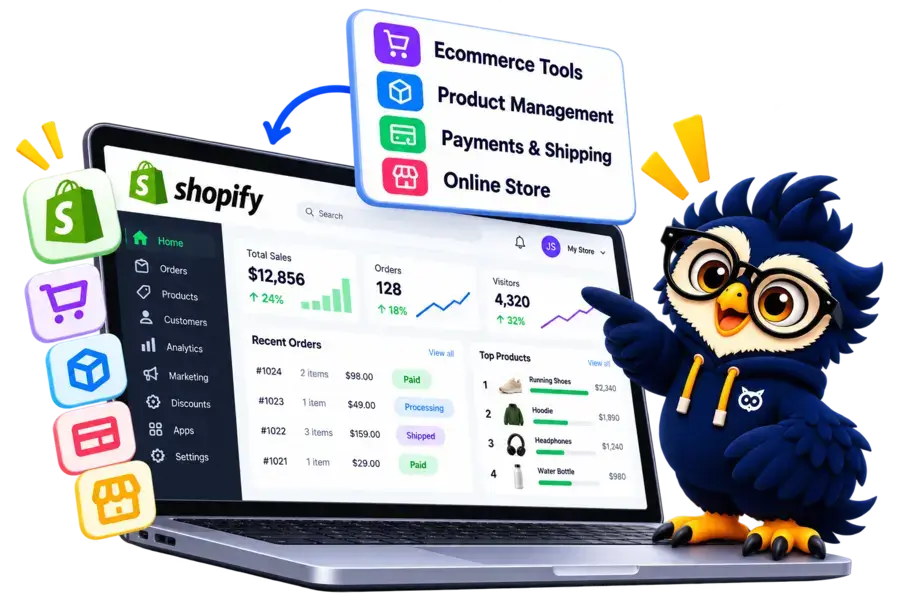
Shopify at a Glance
Shopify is an ecommerce platform designed to help businesses build online stores, sell products, and manage orders from one dashboard. Here’s a quick overview of what it offers and where it fits best.
Main Advantage
Ecommerce-Focused Platform:Build an online store with integrated tools for products, inventory, checkout, and order management.
Main Consideration
Ongoing Costs: Subscription fees, payment processing charges, and paid apps can increase your total operating costs.
Best For
Online Store Owners
Suitable for entrepreneurs, small businesses, and growing brands that want to sell products online.
Store Management
Centralized Dashboard
Manage products, orders, customers, discounts, and sales activity from one place.
Selling Channels
Online and Beyond
Sell through your online store and connect supported marketplaces, social platforms, and in-person sales tools.
Scalability
Small to Large Businesses
Shopify offers plans and features for businesses at different stages, although costs and capabilities vary by plan.
Shopify Ecommerce Platform
Build an online store, manage products and orders, and sell across supported channels
Disclosure: ElegantEspace is supported by readers like you. We may earn an affiliate commission when you purchase through our links. Commissions do not affect our editors’ opinions or evaluations.
What Is Shopify?
Shopify is an ecommerce platform that helps you create an online store, sell products, and manage your business without building an ecommerce system from scratch.
Founded in 2006, Shopify provides tools for designing storefronts, managing products and inventory, processing orders, accepting payments through supported providers, and handling shipping. You can also connect sales channels and add apps to extend your store’s functionality.
Whether you’re launching a small online business, building a direct-to-consumer brand, or expanding an established retail operation, Shopify brings many essential selling tools together in one platform.
But is Shopify worth the cost for your business?
In this Shopify review, we’ll examine its features, pricing, ease of use, SEO capabilities, pros and cons, and alternatives to help you decide whether it’s the right ecommerce platform for you.
What Can You Sell With Shopify?
Shopify supports several types of products and selling models, making it suitable for businesses ranging from small online shops to established retail brands.
Here are some of the main things you can sell with Shopify.
- Physical Products: Sell clothing, electronics, beauty products, home accessories, and other tangible goods. Manage product listings, inventory, and orders from your dashboard.
- Digital Products: Offer downloadable files such as ebooks, templates, digital artwork, and online resources using suitable digital-product tools or apps.
- Print-on-Demand Products: Sell custom-designed T-shirts, mugs, posters, and other merchandise through compatible print-on-demand services.
- Dropshipping Products: Sell products supplied and shipped by third-party suppliers without holding your own inventory. You'll still need to manage customer service and order issues.
- Subscriptions: Offer recurring product deliveries or subscription services using Shopify's subscription features or compatible apps.
- Services and Bookings: Sell consultations, appointments, and other services using suitable product configurations or booking apps.
- Wholesale and B2B Products: Serve business buyers with supported B2B features, subject to your plan and store setup.
- In-Person Sales: Sell at physical locations, markets, or retail stores using Shopify POS, where available.
Is Shopify Suitable for Your Business?
Shopify is particularly useful if your main goal is to sell products and manage orders through a centralized system. It can support several business models, but some require additional apps, integrations, or eligible plans.
Before choosing Shopify, identify what you want to sell and check whether the required payment, fulfillment, subscription, or booking tools are available for your business and country.
Key Features of Shopify
Shopify combines online store creation, product management, checkout, and sales tools in one ecommerce platform. Here are the key features that make it worth considering.
Online Store Builder
Shopify lets you create an online storefront without building an ecommerce website from scratch.
- Choose a theme and customize your store's appearance.
- Create product, collection, and content pages.
- Customize your storefront using the available editor and supported apps.
Product and Inventory Management
Manage your products and stock from Shopify’s centralized dashboard.
- Add product descriptions, images, prices, and variants.
- Organize products into collections.
- Track inventory and manage stock across supported locations.
Secure Checkout and Payments
Shopify provides an integrated checkout experience and supports multiple payment options, depending on your location and setup.
- Accept payments through Shopify Payments where available.
- Connect supported third-party payment providers.
- Configure checkout settings and eligible payment methods.
Order and Customer Management
Shopify helps you manage orders and customer information throughout the selling process.
- Review and process incoming orders.
- Manage fulfillment, cancellations, and refunds.
- Access customer details and order histories.
Themes and Store Customization
Shopify offers free and paid themes for different industries and product categories.
- Customize colors, typography, layouts, and storefront sections.
- Adapt supported themes for mobile devices.
- Extend store functionality with compatible apps and theme features.
Shopify App Store
The Shopify App Store lets you extend your store with additional tools and integrations.
- Add marketing, reviews, loyalty, and customer support tools.
- Connect shipping, accounting, and fulfillment services.
- Integrate compatible tools as your business grows.
Marketing and Sales Channels
Shopify provides tools to promote products and reach customers through supported channels.
- Create discount codes and promotional offers.
- Connect eligible social media and marketplace channels.
- Use available email marketing and customer engagement tools.
Analytics and Reporting
Shopify’s reporting tools help you understand how your store is performing.
- Review sales and order data.
- Track product performance and customer activity.
- Use available reports to identify trends and opportunities.
Shipping and Fulfillment
Shopify helps you manage the process of getting orders to customers.
- Configure shipping rates and delivery options.
- Print shipping labels through supported services.
- Connect fulfillment providers and manage order status.
In-Person Selling With Shopify POS
Shopify POS connects supported in-person sales activities with your Shopify business.
- Sell products at retail stores, markets, and events.
- Manage eligible in-person transactions.
- Sync supported sales and inventory data with your online store.
Shopify Pricing and Plans
Shopify offers multiple pricing plans to help businesses build, manage, and grow their online stores. New users may also qualify for an introductory offer, depending on Shopify’s current promotions.
Shopify’s main plans include essential ecommerce tools for managing products, orders, and sales. Choosing annual billing can reduce the effective monthly cost compared with paying month to month, depending on the plan and current offer.
Whether you’re launching a new store or expanding an established business, you can choose a plan based on your budget and ecommerce needs.
| Plan Name | Best For | Staff Account | Payments Fee | Price | |
|---|---|---|---|---|---|
Basic |
Solo Entrepreneurs |
1 |
2% of 3rd-party payment providers |
$29.00 / month | |
Grow |
Small Teams |
5 |
1% of 3rd-party payment providers |
$79.00 / month | |
Core |
Businesses Expanding Internationally |
15 |
0.6% of 3rd-party payment providers |
$299.00 / month | |
Business |
Complex, high-volume businesses |
Unlimited |
0.2% of 3rd-party payment providers |
$2,300.00 / month |
Accepted Payment Methods
Shopify supports several payment methods for purchasing its subscription plans. Available options depend on your billing country and currency.
Payment Methods for Shopify Subscriptions:
- Credit Cards: Supported Visa, Mastercard, and other eligible card networks.
- Co-branded Debit Cards: Eligible Visa, Mastercard, or RuPay debit cards that support recurring payments.
- UPI: Available for Shopify bills in India when billing is set up in INR.
- Other Regional Options: PayPal, Shopify Balance, and other methods may be available in eligible countries.
Pros and Cons of Shopify
- Easy Store Setup
- Customizable Store Themes
- Extensive App Ecosystem
- Scalable Ecommerce Tools
- Mobile-Friendly Storefronts
- Multiple Sales Channels
- Built-In SEO and Marketing Tools
- Centralized Store Management
- Monthly Subscription Costs
- Additional Transaction Fees May Apply
- Extra Costs for Paid Apps
- Advanced Customization May Require Coding
- Less Flexibility Than Self-Hosted Platforms
Ready to Launch Your Online Store with Shopify?
Turn your business idea into an online store with Shopify’s powerful ecommerce tools, customizable themes, and streamlined store management. Explore Shopify to see how you can start selling online and grow your business.
Shopify Ease of Use: How Easy Is It to Build an Online Store?
Shopify is designed to make online selling accessible to beginners, even if you have no coding experience.
Its guided setup, store editor, and centralized dashboard help you build a storefront and manage essential ecommerce tasks from one place.
1. Setting Up Your Store
After creating an account, you can start configuring your store by adding products, choosing a theme, and setting up essential business details.
Shopify guides you through key steps, including payment settings, shipping options, and store configuration. The exact setup depends on what you plan to sell and where your business operates.
2. Designing Your Storefront
Shopify’s theme editor lets you customize your store’s layout, colors, typography, images, and sections without coding for routine changes.
You can start with a free or paid theme and adjust it to match your brand. More advanced customization may require editing code or using additional apps.
3. Adding Products and Managing Orders
The Shopify dashboard brings product listings, inventory, orders, and customer information together in one place.
You can add product images, descriptions, prices, and variants, then manage orders as customers make purchases.
This centralized workflow makes routine store management easier as your product catalog grows.
4. Extending Your Store
If you need features beyond Shopify’s built-in tools, you can explore apps for reviews, email marketing, subscriptions, shipping, and other business needs.
However, choosing and configuring multiple apps can add complexity and extra costs, so install only what your store actually needs.
Is Shopify Easy for Beginners?
Yes, Shopify is beginner-friendly for launching and managing an online store.
Its guided setup and centralized dashboard reduce the need to handle separate ecommerce systems.
However, running a store still involves product sourcing, pricing, payments, shipping, customer service, and marketing.
Shopify simplifies the technical side of selling, but it doesn’t eliminate the work required to run a business.
Shopify Themes and Store Design
Shopify offers free and paid themes that help you create a professional online storefront without designing everything from scratch.
You can choose a theme that fits your brand and customize its layout, colors, typography, images, and sections.
1. Free and Paid Themes
Shopify’s Theme Store includes themes for different industries and product types.
Free themes are a good starting point for new businesses, while paid themes may offer additional layouts and design options.

2. Customize Your Storefront
Shopify’s theme editor lets you adjust page sections, product layouts, colors, fonts, and images without coding for routine changes.
You can create a consistent look across your homepage, product pages, collections, and other store pages.
3. Mobile-Friendly Designs
Shopify themes are designed to support mobile devices, helping customers browse products and shop on smaller screens.
Still, preview your storefront on mobile and check product images, navigation, buttons, and checkout usability before launch.
4. A Limitation: Changing Templates Later
Shopify provides useful customization options, but advanced changes may require Liquid, CSS, or other coding skills. Some design features also depend on your chosen theme or installed apps.
Switching themes is possible, but you may need to review and reconfigure theme-specific settings and layouts after changing.
Are Shopify Themes Good Enough for a Professional Store?
Yes. Shopify themes provide a practical foundation for professional online stores, especially if you want to launch quickly.
Choose a theme based on your product catalog, brand, and required features, rather than appearance alone.
Shopify SEO Features: Is Shopify Good for SEO?
Shopify includes built-in SEO tools that help store owners optimize product pages, collections, blog posts, and other website content.
It also handles several technical SEO tasks automatically, making it easier to manage a store without extensive technical knowledge.
1. Edit Page Titles and Meta Descriptions
You can customize SEO titles and meta descriptions for product pages, collections, blog posts, and other pages.
This helps you describe your content accurately and improve how your pages appear in search results.
2. Automatic XML Sitemap and Canonical URLs
Shopify automatically generates an XML sitemap and canonical URLs.
These help search engines discover your pages and identify preferred URLs when similar versions exist. You can submit your sitemap through Google Search Console.
3. Customize URLs and Image Alt Text
Shopify lets you edit supported URL handles and add descriptive alt text to product and other images.
Clear URLs and useful image descriptions help search engines understand your content and improve accessibility.
4. Redirects and Technical SEO
Shopify supports URL redirects, which are useful when changing product URLs or removing pages.
It also provides default robots.txt rules and automatically applies SSL certificates to help establish a secure website.
Advanced technical changes may require coding or additional expertise.
5. Structured Data and International SEO
Shopify themes include structured data to help search engines understand product information.
Shopify also supports international SEO features, including localized domains and language-related settings, for eligible store configurations.
Is Shopify Good for SEO?
Yes, Shopify provides the essential SEO tools most online stores need.
Its automatic technical features and editable page settings make it practical for merchants who want to focus on selling rather than managing website infrastructure.
However, Shopify doesn’t guarantee higher rankings.
Your results still depend on product content, keyword research, site performance, competition, backlinks, and the overall quality of your SEO strategy.
Shopify Payment Options and Transaction Fees
Shopify offers integrated payment processing in supported countries and lets merchants connect third-party payment providers.
However, the payment methods available and the fees you pay depend on your store’s location, selected plan, and payment setup.
1. Shopify Payments
Shopify Payments lets eligible merchants accept card payments directly through their store without setting up a separate payment processor.
- Integrated with Shopify's checkout.
- Payment processing rates vary by plan and location.
- No additional Shopify third-party transaction fee on eligible orders processed through Shopify Payments.
2. Third-Party Payment Providers
If Shopify Payments isn’t available in your country, you can connect a supported third-party payment provider.
- Choose from payment providers available for your region.
- Pay the provider's payment processing fees.
- Shopify may charge an additional third-party transaction fee, depending on your plan and payment setup.
3. Shopify Transaction Fees
Your total payment cost includes payment processing fees and Shopify transaction fees.
These are separate charges, so check which apply to your chosen payment setup before launching your store.
Shopify’s published US pricing, for example, lists online card rates starting at 2.9% + 30¢ USD on Basic with annual billing. Rates vary across plans and may differ for other countries.
Is Shopify's Payment System Worth It?
Shopify’s integrated checkout makes it convenient to manage online sales, but payment costs can add up as your order volume grows.
Compare the available payment providers and their fees before deciding which setup works best for your business.
Important: Shopify Payments is not available in every country. Always verify regional availability and current rates before publishing your pricing comparison.
Shopify Customer Support: How Good Is It?
Shopify offers 24/7 chat support, a detailed Help Center, and a community forum to help merchants resolve common issues.
- 24/7 Chat Support: Get help with store-related questions.
- Help Center: Find setup guides, tutorials, and troubleshooting resources.
- Community Forum: Learn from other merchants and experienced contributors.
Shopify Security and Reliability
Shopify is a hosted ecommerce platform that manages much of the technical infrastructure needed to run an online store, including SSL certificates and platform security updates.
- SSL Certificates: Encrypt data exchanged between your store and its visitors.
- PCI Compliance: Shopify's payment environment supports PCI-compliant payment processing.
- Platform Maintenance: Shopify manages hosting infrastructure and routine platform updates.
- Account Security: Features such as two-step authentication help protect merchant accounts.
Is Shopify Worth It in 2026? Final Verdict
Shopify is one of the strongest options for businesses that want to build an online store and manage products, orders, payments, and sales channels from one platform.
Its beginner-friendly interface, extensive app ecosystem, and scalable ecommerce tools make it suitable for businesses at different stages.
However, subscription fees, payment processing charges, and paid apps can increase your overall costs.
Businesses that want greater control over their website or prefer a self-hosted solution may find WooCommerce a better fit.
Who Should Choose Shopify?
- Beginners: Want an accessible way to launch an online store.
- Small Businesses: Need centralized product and order management.
- Growing Brands: Want to expand sales across multiple channels.
- Retailers: Need online selling alongside supported in-person sales tools.
Who Should Consider Alternatives?
- Budget-Conscious Users: Want to minimize ongoing platform costs.
- WordPress Users: Prefer greater ownership and customization with WooCommerce.
- Design-Focused Businesses: Want a website builder centered on visual presentation.
Ready to Launch Your Online Store with Shopify?
Turn your business idea into an online store with Shopify’s powerful ecommerce tools, customizable themes, and streamlined store management. Explore Shopify to see how you can start selling online and grow your business.
Frequently Asked Questions About Shopify
1. Is Shopify good for beginners?
Yes. Shopify offers guided store setup, customizable themes, and a centralized dashboard that makes launching and managing an online store easier for beginners.
2. How much does Shopify cost?
Shopify’s US Basic plan starts at $29 per month when billed yearly.
Higher-tier plans cost more, and payment processing, paid apps, and themes may increase your total expenses.
3. Does Shopify offer a free plan?
Shopify does not generally offer a permanent free plan.
It may provide promotional trials or introductory offers, depending on the current offer and your region.
4. Can I use Shopify without coding?
Yes. You can build and manage a store using its visual theme editor and built-in tools.
Advanced customization may require coding or developer assistance.
5. Is Shopify good for SEO?
Yes. Shopify includes essential SEO features such as editable page titles, meta descriptions, automatic sitemaps, and canonical URLs.
However, rankings depend on your content, competition, site quality, and SEO strategy.
6. Does Shopify charge transaction fees?
Shopify charges payment processing fees, and additional third-party transaction fees may apply when you use an external payment provider.
The exact costs depend on your plan, location, and payment setup.
7. Can I sell digital products on Shopify?
Yes. You can sell ebooks, digital artwork, templates, and other downloadable products using suitable apps or digital product tools.
8. Is Shopify better than WooCommerce?
It depends on your needs.
Shopify offers a managed ecommerce platform with centralized tools, while WooCommerce provides greater control through WordPress but requires more responsibility for hosting, maintenance, and configuration.
9. Can I use my own domain with Shopify?
Yes. You can connect an existing domain or purchase a new one. Domain registration and renewal costs may apply separately.
10. Can I migrate my store to Shopify?
Yes. You can migrate products, customers, orders, and other data using supported import tools, apps, or migration services.
The process depends on your existing platform, and some data may require manual transfer.
User Reviews and Ratings of Shopify
There are no reviews yet. Be the first one to write one.

Shopify Alternative

Hostinger AI
Best for design flexibility
A visual website builder with extensive templates, drag-and-drop editing, and AI-powered design tools. A good choice if you want more creative control.

Wix
Best for website design
Wix offers an intuitive website builder with customizable templates, drag-and-drop editing, AI-powered design tools, and built-in business features.