
Helping beginners build websites since 2017
400K+
Readers Helped
Updated for 2026
Latest Method
100%
Beginner Friendly
Disclosure: ElegantEspace is supported by readers like you. We may earn an affiliate commission when you purchase through our links. Commissions do not affect our editors’ opinions or evaluations.
What Are SEO Myths and Misconceptions?
SEO myths and misconceptions are incorrect, outdated, or misleading beliefs about how search engine optimization works.
They often develop from outdated SEO practices, misunderstood ranking factors, or assumptions about how search engines evaluate websites.
For example, some website owners believe that repeating a target keyword multiple times guarantees higher rankings.
In reality, keyword stuffing can make content unnatural and negatively affect the user experience.
Understanding these misconceptions helps you avoid ineffective SEO practices and focus on strategies that improve your website’s content, usability, and search visibility.
Why Is It Important To Understand SEO Myths?
Following incorrect SEO advice can waste time, lead to ineffective optimization, and distract you from strategies that actually improve your website.
Understanding common SEO myths helps you:
- Avoid Outdated Practices: Stop relying on techniques that no longer align with modern search guidelines.
- Make Better SEO Decisions: Focus your efforts on useful content, website quality, and user experience.
- Prevent SEO Mistakes: Avoid keyword stuffing, manipulative link building, and other harmful practices.
- Use Resources Effectively: Spend your time and budget on strategies that support long-term growth.
- Adapt to Search Changes: Understand how search engines evolve and adjust your SEO approach accordingly.
The goal is simple: Focus on what works, question outdated advice, and build your SEO strategy on reliable information.
15 Common SEO Myths and Misconceptions
SEO advice changes as search engines evolve. However, many outdated beliefs continue to influence how website owners optimize their content.
Let’s examine some common SEO myths, understand the facts, and learn what you should actually do.
SEO Is a One-Time Activity
Search rankings can change as competitors publish new content, search algorithms evolve, and user expectations shift.
SEO requires regular monitoring and updates to maintain your website’s relevance, performance, and search visibility.
What Should You Do?
- Update Existing Content: Refresh outdated information, statistics, links, and examples to keep your articles relevant.
- Monitor Search Performance: Use Google Search Console to track impressions, clicks, search queries, and ranking changes.
- Fix Technical Issues: Regularly check for broken links, indexing problems, slow-loading pages, and mobile usability issues.
- Review Keyword Performance: Monitor changes in search demand and identify new opportunities to improve your content.
- Analyze Competitors: Review competing pages to understand how search results and user expectations are changing.
The reality: SEO is an ongoing process. Regularly reviewing and improving your website helps you adapt to changes and maintain a strong search presence.
Keyword Density Is a Google Ranking Factor
Keyword density refers to how frequently a target keyword appears in your content compared with the total word count.
Some website owners believe that repeating a keyword at a particular percentage helps improve search rankings.
However, Google does not recommend maintaining a fixed keyword density. Repeating keywords unnecessarily can make content difficult to read and lead to keyword stuffing.
What Should You Do?
- Use Keywords Naturally: Include your primary keyword where it fits the topic and context.
- Cover Related Topics: Use relevant terms, questions, and subtopics to explain the subject thoroughly.
- Write for Readers: Prioritize clear, useful explanations instead of targeting a specific keyword percentage.
- Avoid Keyword Stuffing: Don't force keywords into headings, paragraphs, or image descriptions.
Example: Instead of repeating “best web hosting” throughout an article, use natural variations such as “web hosting providers,” “hosting plans,” and “choosing a hosting service” where relevant.
The reality: Focus on relevance, context, and helpful content rather than a fixed keyword density.
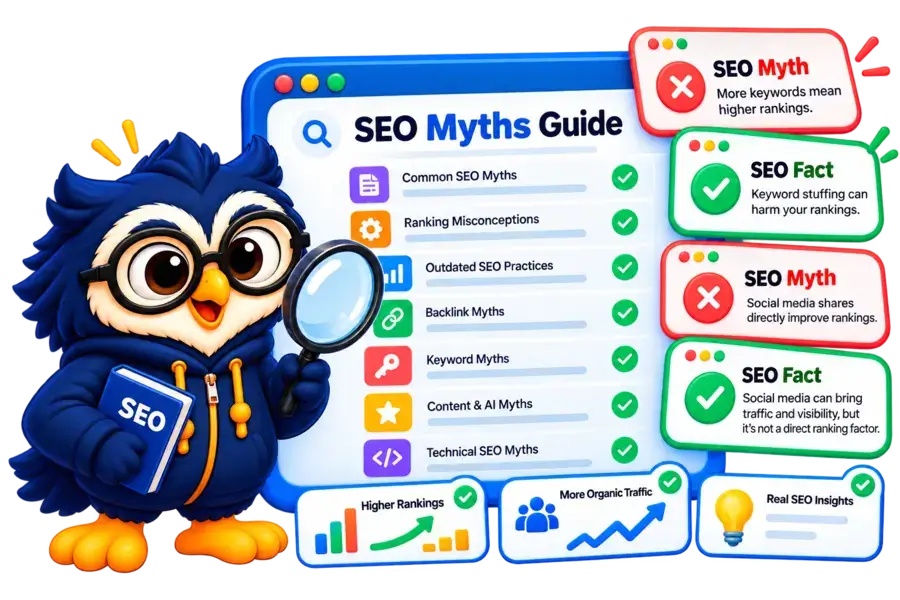
More Keywords Mean Higher Rankings
Search engines focus on understanding the topic, relevance, and usefulness of content rather than simply counting keywords.
Unnecessary keyword repetition can make your content confusing, unnatural, and difficult to read. It may also lead to keyword stuffing.
What Should You Do?
- Target a Primary Keyword: Identify the main search query your page should address.
- Include Relevant Variations: Use related terms and phrases naturally where they help explain the topic.
- Cover Search Intent: Answer the questions and needs behind your target keyword.
- Organize Your Content: Use descriptive headings to cover important subtopics.
- Avoid Unnecessary Repetition: Remove keywords that do not add meaning or value.
Example: If your target keyword is “WordPress hosting,” you can naturally discuss hosting plans, server performance, website security, and hosting providers without repeatedly inserting the same phrase.
The reality: Focus on covering a topic thoroughly and naturally. More keywords do not guarantee better rankings.
Publishing More Content Always Improves Rankings
Search engines prioritize helpful, relevant content rather than simply rewarding websites for publishing frequently.
Publishing too many low-quality, repetitive, or poorly researched articles can waste resources and make it harder to maintain content quality.
What Should You Do?
- Prioritize Quality: Publish well-researched content that provides genuine value to readers.
- Understand Search Intent: Make sure each article addresses what users are actually looking for.
- Avoid Content Duplication: Don't publish multiple articles covering the same topic without a clear purpose.
- Update Existing Articles: Improve outdated content instead of constantly creating new pages.
- Follow a Content Strategy: Choose topics based on audience needs, keyword research, and your website's goals.
Example: Instead of publishing five short articles about WordPress hosting, create one comprehensive guide comparing hosting types, features, pricing, and providers.
The reality: A smaller collection of useful, well-maintained articles can be more valuable than a large library of thin or repetitive content.
Backlinks Are the Only Important Ranking Factor
Google considers many signals when determining which pages are relevant and useful for a search query.
Content quality, search intent, page experience, technical accessibility, and other factors also contribute to your website’s SEO performance.
What Should You Do?
- Create Helpful Content: Publish accurate, relevant information that addresses your audience's needs.
- Optimize Your Pages: Improve title tags, headings, URLs, images, and internal links.
- Improve Technical SEO: Ensure search engines can crawl and index your important pages.
- Build Relevant Backlinks: Earn links from credible websites through useful content and genuine relationships.
- Monitor Performance: Use Google Search Console to understand how your pages perform in search results.
Example: A website with thousands of backlinks may still struggle to rank if its content does not satisfy search intent or its pages have serious technical problems.
The reality: Backlinks can support SEO, but sustainable search visibility requires a balanced strategy that includes content quality, on-page optimization, technical SEO, and website credibility.
Domain Authority Is a Google Ranking Factor
Domain Authority (DA), developed by Moz, estimates how likely a website is to rank in search results.
Other SEO tools provide similar metrics, such as Domain Rating (DR) from Ahrefs and Authority Score from Semrush.
Some website owners believe that increasing their DA or DR directly improves Google rankings. However, Google does not use these third-party scores as ranking factors.
What Should You Do?
- Focus on Quality Backlinks: Earn relevant links from trustworthy websites rather than chasing higher authority scores.
- Publish Helpful Content: Create useful resources that deserve to be referenced by other websites.
- Build Brand Credibility: Develop a genuine reputation within your industry.
- Use SEO Metrics Carefully: Treat DA, DR, and Authority Score as comparison tools, not measures of Google's ranking decisions.
- Monitor Actual Performance: Use Google Search Console to track organic clicks, impressions, and search visibility.
Example: A website with a DA of 25 can rank above a website with a DA of 60 if its page better satisfies the search query.
The reality: Domain Authority can help compare websites, but improving your website’s actual content, relevance, and credibility should be your priority.
Duplicate Content Always Leads to a Google Penalty
Duplicate content refers to substantial portions of content that appear on multiple URLs, either on the same website or across different websites.
Some website owners worry that publishing similar content will automatically trigger a penalty or cause their entire website to lose rankings.
However, Google generally handles duplicate content by selecting a representative version of similar pages to show in search results.
The bigger concern is when duplicate pages create confusion, compete for visibility, or offer little unique value to users.
What Should You Do?
- Create Original Content: Provide unique information, examples, and insights wherever possible.
- Use Canonical Tags: Identify the preferred version of similar or duplicate pages when appropriate.
- Manage URL Variations: Avoid creating unnecessary duplicate URLs through filters and parameters.
- Consolidate Similar Pages: Combine overlapping articles when they serve the same search intent.
- Check Indexing: Use Google Search Console to identify indexing and canonicalization issues.
Example: If your website has separate URLs for the same product page with different tracking parameters, Google may treat them as duplicate versions and select one canonical URL.
The reality: Duplicate content does not automatically trigger a penalty, but managing duplicate URLs and providing original, useful content helps search engines understand which pages should appear in search results.
Meta Descriptions Directly Affect Google Rankings
A meta description is a short summary of a webpage that may appear below its title in search results.
Some website owners believe that including target keywords in this description directly improves rankings.
However, Google does not use the meta description as a direct ranking factor.
It may use the description to generate a search snippet, although it can also display text from the page that better matches a user’s query.
What Should You Do?
- Write Unique Descriptions: Create a relevant summary for each important page.
- Include Keywords Naturally: Use your primary keyword where it fits naturally.
- Explain the Page's Value: Clearly communicate what visitors can expect to find.
- Encourage Clicks: Write compelling descriptions that help users decide whether to visit your page.
Example: For an article about beginner-friendly web hosting, write a description explaining what hosting options it compares, what features it covers, and who the guide is for.
The reality: Meta descriptions don’t directly improve rankings, but well-written descriptions can help users understand your page and encourage relevant clicks.
Longer Content Always Ranks Better
Some website owners believe that writing longer articles automatically improves their chances of ranking higher on Google.
As a result, they add unnecessary paragraphs and repeat information just to increase their word count.
However, Google does not require a specific word count for content to rank.
What matters is whether a page provides useful, relevant, and satisfying information for its audience.
What Should You Do?
- Match Search Intent: Understand what users expect when they search for your target keyword.
- Cover the Topic Effectively: Include important information without adding unnecessary details.
- Prioritize Clarity: Explain concepts in simple language and organize content with descriptive headings.
- Add Useful Examples: Support explanations with practical examples, data, and relevant visuals.
- Remove Filler Content: Avoid repeating ideas just to make an article longer.
Example: A straightforward guide explaining how to install WordPress may only need a few clear steps, while a comprehensive guide comparing web hosting providers may require more detailed explanations.
The reality: Focus on content completeness, relevance, and usefulness rather than targeting an arbitrary word count.
Google Ads Improve Organic Search Rankings
Some website owners believe that running Google Ads campaigns will help their website rank higher in Google’s organic search results.
However, paid advertising and organic search rankings are separate systems.
Google Ads allows businesses to display paid advertisements for selected search queries, while organic rankings are determined independently by Google’s search systems.
What Should You Do?
- Use Google Ads for Paid Visibility: Reach potential customers through targeted advertising campaigns.
- Invest in Organic SEO: Improve content quality, keyword targeting, technical SEO, and website usability.
- Measure Both Channels: Use analytics to understand how paid and organic traffic contribute to your business goals.
- Create a Balanced Strategy: Use paid campaigns for immediate exposure while building long-term organic visibility.
Example: A website may appear at the top of Google through a paid advertisement without ranking on the first page of organic search results for the same keyword.
The reality: Google Ads can increase paid traffic and brand exposure, but purchasing ads does not directly improve your organic search rankings.
Social Media Shares Directly Improve Google Rankings
Likes, comments, followers, and shares do not directly determine where a webpage appears in Google’s organic search results.
However, social media can help your content reach a wider audience and create opportunities that indirectly support your SEO efforts.
When people discover and find value in your content, they may visit your website, mention your brand, or reference your articles from their own websites.
What Should You Do?
- Share Useful Content: Promote your blog posts, guides, and resources on relevant social platforms.
- Choose the Right Platforms: Focus on channels where your target audience is active.
- Engage With Your Audience: Answer questions, participate in discussions, and build meaningful connections.
- Build Brand Awareness: Share industry insights and maintain a consistent online presence.
- Encourage Natural References: Create valuable content that others may want to mention or link to.
Example: Sharing a detailed WordPress tutorial on LinkedIn can introduce it to developers and website owners. Someone who finds it useful may reference it in their own article, creating an opportunity to earn a backlink.
The reality: Social media shares do not directly improve Google rankings, but content promotion can increase visibility, referral traffic, and opportunities to earn natural backlinks.
SEO Results Are Immediate
Unlike paid advertising, where visibility can begin shortly after a campaign launches, SEO generally requires consistent effort before meaningful results appear.
Search engines need time to discover, crawl, and index pages. Rankings can also depend on competition, content relevance, website quality, and other factors.
What Should You Do?
- Set Realistic Goals: Focus on gradual improvements rather than expecting instant rankings.
- Publish Helpful Content: Create resources that satisfy your audience's search intent.
- Improve Existing Pages: Update outdated information and address content gaps.
- Monitor Performance: Track impressions, clicks, and search queries using Google Search Console.
- Stay Consistent: Continue improving your website instead of frequently changing strategies due to short-term ranking fluctuations.
Example: A newly published article may take time to appear in search results and gain visibility. Even after indexing, it may need further improvements to compete for its target keywords.
The reality: SEO is a long-term investment. Consistent optimization and useful content can improve your chances of achieving sustainable search visibility, but no fixed timeline or ranking is guaranteed.
Every Page Must Rank for One Keyword
A single page can rank for multiple related search queries when its content covers the topic comprehensively and satisfies different variations of search intent.
For example, an article targeting “best web hosting for beginners” may also appear for searches such as “beginner-friendly web hosting,” “hosting for new websites,” and “easy web hosting services.”
What Should You Do?
- Choose a Primary Keyword: Identify the main search query and purpose of each page.
- Include Related Keywords: Naturally cover relevant variations and subtopics.
- Understand Search Intent: Address the questions and needs behind related searches.
- Organize Content Clearly: Use descriptive headings to cover important aspects of the topic.
- Avoid Keyword Cannibalization: Don't create multiple pages targeting the same search intent without a clear reason.
The reality: Focus each page on a clear topic and search intent, not just one exact keyword. A well-optimized page can rank for many relevant search queries.
AI-Generated Content Is Automatically Penalized by Google
AI tools can help with research, brainstorming, outlining, and drafting.
However, using AI to produce large amounts of low-quality content primarily to manipulate search rankings can violate Google’s spam policies.
Google focuses on the quality, usefulness, and purpose of content rather than whether it was written by a human or generated with AI.
What Should You Do?
- Add Original Insights: Include your own experience, expertise, examples, and analysis.
- Verify Information: Check facts, statistics, and references before publishing.
- Edit AI Drafts: Improve accuracy, clarity, tone, and readability instead of publishing raw outputs.
- Prioritize Readers: Make sure the content answers users' questions and provides genuine value.
- Avoid Mass Content Production: Don't generate large volumes of pages with little original value just to target keywords.
Example: Using AI to create an outline for a WordPress hosting guide is a reasonable workflow. Publishing hundreds of unreviewed AI-generated articles with repetitive information and no added value is not.
The reality: AI-generated content is not automatically against Google’s guidelines. Content created primarily to manipulate search rankings, regardless of how it is produced, can be considered spam.
Submitting a Sitemap Guarantees Indexing
An XML sitemap helps search engines discover important URLs on your website. However, submitting it does not force Google to crawl or index those pages.
Google decides which pages to index based on factors such as content quality, relevance, accessibility, and indexing requirements.
What Should You Do?
- Create an XML Sitemap: Include the important, canonical URLs you want search engines to discover.
- Submit It to Google Search Console: Add your sitemap through the Sitemaps report.
- Check Indexing Status: Use the URL Inspection tool to understand whether individual pages are indexed.
- Improve Content Quality: Make sure pages provide useful, original information.
- Fix Technical Issues: Check for crawl blocks, incorrect canonical tags, and unintended noindex directives.
- Build Internal Links: Link to important pages from relevant sections of your website.
Example: You submit a sitemap containing 50 URLs to Google Search Console. Google may discover all 50 URLs but choose to index only some of them.
The reality: A sitemap helps Google discover your pages, but indexing is not guaranteed. Focus on making your important pages accessible, useful, and technically sound.
What Actually Matters for SEO?
Understanding SEO myths is only the first step.
To build a sustainable SEO strategy, focus on the practices that help search engines understand your website and provide users with useful information.
Here are the key areas to prioritize:
- Helpful, Relevant Content: Publish accurate, original content that addresses users' questions and search intent.
- Keyword Research: Identify relevant search queries and understand what your audience is looking for.
- On-Page Optimization: Improve title tags, headings, URLs, images, and internal links.
- Technical SEO: Ensure your website is crawlable, indexable, mobile-friendly, and performs well.
- Quality Backlinks: Earn relevant editorial links through useful content and genuine industry relationships.
- User Experience: Make your website easy to navigate, understand, and use.
- Performance Monitoring: Use Google Search Console and Google Analytics 4 to track organic traffic, search visibility, and conversions.
The key takeaway: Successful SEO is not about following shortcuts or chasing individual ranking factors. It is about creating a technically sound website with useful content that meets your audience’s needs.
How to Identify Outdated SEO Advice
SEO practices evolve as search engines improve their systems.
Advice that worked several years ago may no longer be effective or may even conflict with current search guidelines.
Before implementing an SEO recommendation, evaluate its source and purpose.
- Check Official Documentation: Refer to Google's Search Central documentation for current guidance.
- Verify Ranking Claims: Don't assume every SEO metric or technique is a confirmed Google ranking factor.
- Check Publication Dates: Review when an article was published and whether its recommendations have been updated.
- Look for Evidence: Prefer advice supported by official documentation, practical testing, or reliable industry research.
- Avoid Guaranteed Results: Be cautious of services promising instant rankings, hundreds of backlinks, or guaranteed first-page positions.
- Understand the Context: SEO recommendations should match your website, audience, and goals rather than follow a universal formula.
The reality: Don’t follow SEO advice simply because it is popular. Verify the information, understand why a technique works, and prioritize recommendations that align with current search guidelines.
Final Thoughts
SEO is constantly evolving, and outdated myths can lead to ineffective strategies and wasted effort.
Understanding how search engines work helps you avoid common mistakes and focus on practices that genuinely improve your website.
Prioritize helpful content, relevant keywords, technical performance, quality backlinks, and a positive user experience.
Regularly monitor your results and adapt your strategy as search evolves.
Successful SEO isn’t about chasing shortcuts or following every popular tip. It’s about making informed decisions and consistently improving your website for both users and search engines.
Continue Your SEO Journey
Build your skills one step at a time with these essential SEO guides.
Technical SEO
Improve site health
Help search engines discover, crawl, and index your important website pages effectively.
The SEO Checklist
Optimize your website
Use a practical checklist to review your website, identify optimization opportunities, and implement essential SEO improvements.


hi great work and keep it up
Hi,
Thanks for sharing awesome information.
Hi ! this is very nice post and very help full.
You are doing great work keep the good work.
Hy,
Very good article, paragti article nice professional blogger
The respect blogger Pragati
Thank you!!
Hy, this is good article and very help ful
You have can very good motivation articles good work
I really appreciate this wonderful post I assure this would be beneficial for most of the people. Thanks for sharing the information keep updating.
I am very interested in this topic and glad to find some information about it here.